The pioneers of home gaming that laid the foundations of the industry (1972-1977).
These systems predate interchangeable cartridges and were largely built around fixed or very limited game libraries.
Magnavox Odyssey (1972): The Magnavox Odyssey is widely recognised as the first commercial home video game console. Using simple analogue circuitry and physical overlays, it laid the foundation for the entire home gaming industry.
Ping-O-Tronic (Philips): Philips’ Ping-O-Tronic was one of the earliest European home consoles, offering built-in Pong-style games. It reflected the rapid global adoption of television-based gaming following the Odyssey’s success.
TV Tennis Electrotennis: TV Tennis Electrotennis was an early dedicated console built to simulate simple tennis-style gameplay on home televisions. It represents the earliest wave of single-game home gaming systems.
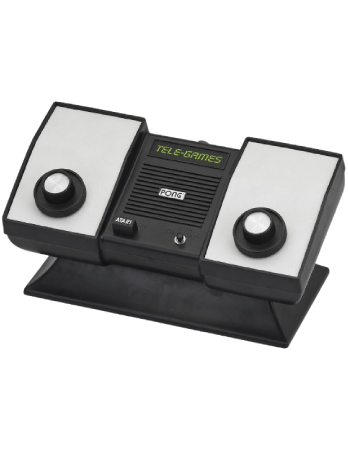
Home Pong systems (various manufacturers): Home Pong systems were a broad category of dedicated consoles produced by multiple manufacturers in the mid-1970s. These devices focused exclusively on Pong-style games and popularised home gaming worldwide.
Coleco Telstar series: The Coleco Telstar series was a successful line of dedicated Pong consoles that brought simple multiplayer gaming into millions of homes. Its accessibility helped cement Coleco as a major early player in the console market.
Binatone TV Master series: The Binatone TV Master series offered affordable, mass-market Pong consoles, particularly popular in Europe. These systems emphasised simplicity and family-friendly play over technical innovation.
Interton Video 2000: Interton’s Video 2000 was a German-made Pong-style console that highlighted Europe’s early contribution to home gaming hardware. It featured multiple built-in game variations using analogue electronics.
APF TV Fun series: The APF TV Fun series consisted of dedicated Pong consoles that later evolved into cartridge-based systems. It represents an important transition point between single-game consoles and programmable home gaming platforms.
Characteristics: no CPUs, simple analogue circuitry, built-in games only.